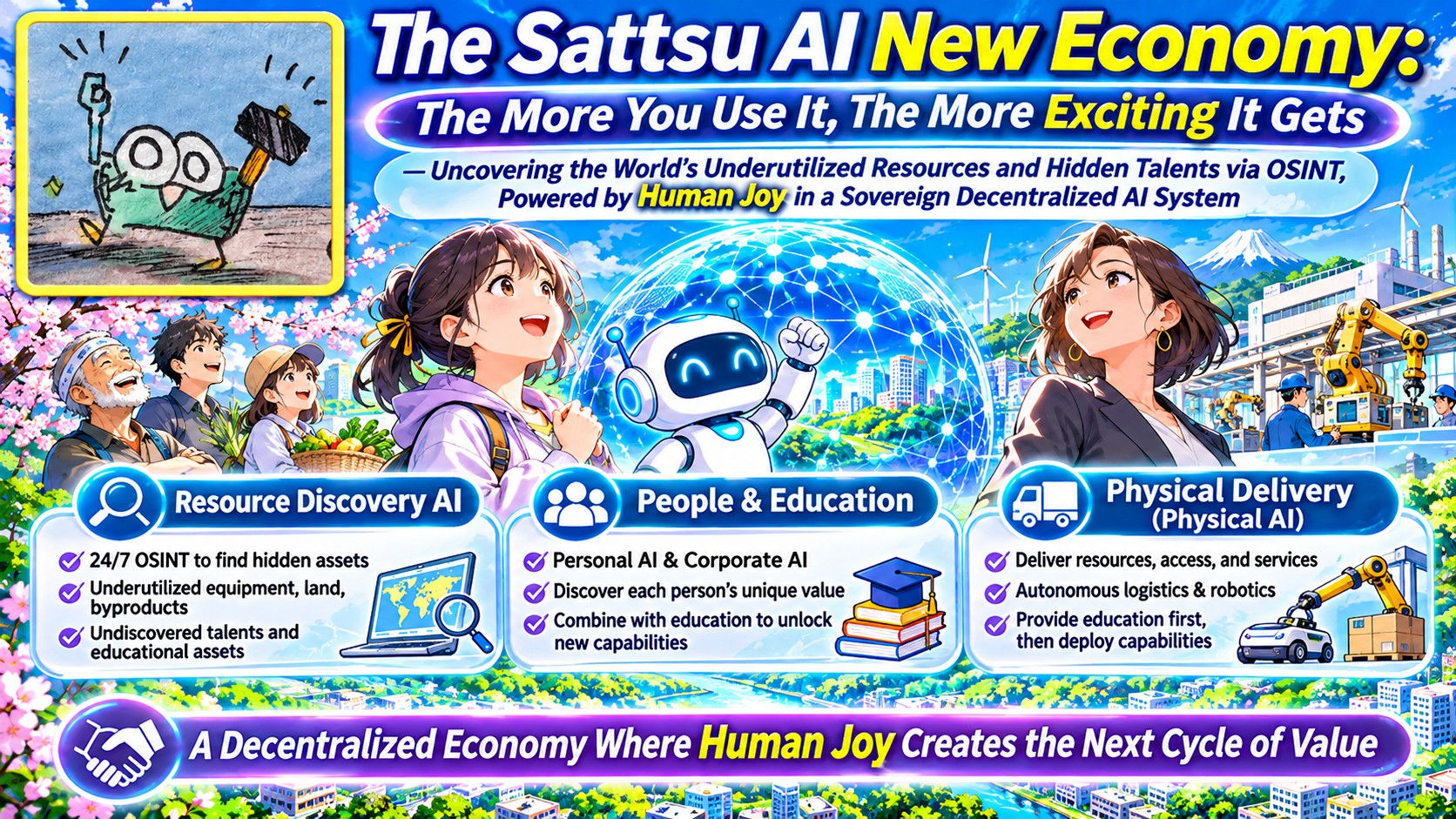
— Uncovering the World’s Underutilized Resources and Hidden Talents via OSINT, Powered by Human Joy in a Sovereign Decentralized AI System
I am currently designing a new social and economic system.
I have named this overarching vision “The Sattsu AI New Economy: The More You Use It, The More Exciting It Gets.” Before moving into full-scale software development and AI engineering, my first step is to put these concepts and shared vocabulary into public circulation to build a common foundation of understanding. In this article, I am publishing the complete, unabridged architectural design.
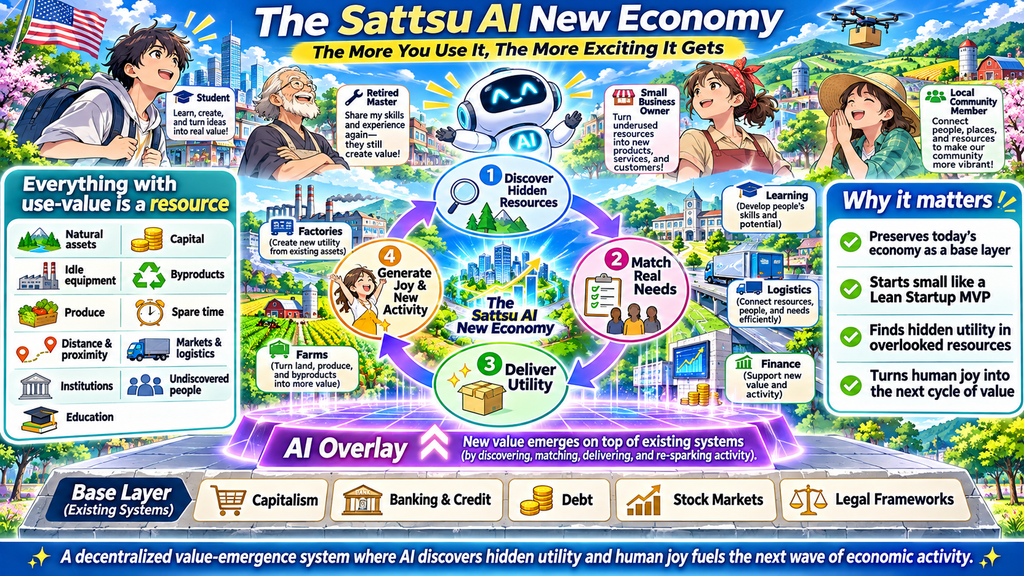
First and foremost, let me be clear: this is not a revolutionary manifesto aimed at tearing down or replacing our existing social and economic systems overnight—namely capitalism, equity financing and stock trading, banking credit creation, debt contracts, or established legal frameworks.
Instead, all existing social and economic infrastructure is preserved intact as a robust “Base Layer.” Placed directly on top of it is an “AI Overlay”—a new mechanism designed in the spirit of a Lean Startup MVP (Minimum Viable Product) that can be improved and adopted incrementally. Even when deployed on a very small scale, it delivers immediate, tangible economic and social utility within that scope. At the same time, it represents a foundational, flagship use case for the next era of AI.
Defined in a single sentence: It is a sovereign, decentralized value-emergence system where AI-driven OSINT (Open-Source Intelligence) deep research continuously discovers the hidden use-value of the world’s “underutilized resources,” and the human “joy” generated by putting them to use becomes the driving engine for the next wave of economic activity.
- 1. Redefining “Resources”: From Physical Assets, Space, and Institutions to “Undiscovered People” and “Education”
- 2. A Sovereign, Decentralized AI Network: Integrating Generative, Industrial, and Physical AI
- 3. “Triple Delivery” and “Reverse Offers” That Drive the Economy
- 4. Shifting from an “Ad-Driven Economy” to a “Joy-Driven Economy”
- 5. Starting Small, Scaling Organically via MVPs
1. Redefining “Resources”: From Physical Assets, Space, and Institutions to “Undiscovered People” and “Education”
In conventional economic systems, markets primarily trade standardized goods and labor that already carry an explicit market price (exchange-value) and clearly defined ownership. By contrast, The Sattsu AI New Economy encompasses everything that possesses potential use-value (utility). Elements that traditional economics separates into entirely different silos are treated cross-functionally on the same plane as “resources”:
- Natural, Agricultural, and Industrial Resources: Underutilized natural assets, agricultural, forestry, and marine produce (including off-spec items), manufactured goods, idle factory equipment, and industrial byproducts or scrap materials generated during production.
- Financial, Market, and Logistics Resources: Capital, equities, debt instruments, credit lines, diverse existing marketplaces, and varied delivery networks—ranging from empty return-trip truck capacity to last-mile delivery services.
- Temporal and Spatial Resources: “Spare time” across both machinery and people, as well as physical proximity and distance. Being physically close is an independent resource that saves energy and lead time, whereas physical distance can also serve as a resource through environmental differences or regional scarcity.
- Institutional and Organizational Resources: Corporations, cooperatives, industry associations, local governments, political mechanisms (self-governing bodies), local regulations, and licensing frameworks. Rather than viewing institutions as bureaucratic obstacles to overcome, this system treats them as vital “institutional vessels” to be combined with other assets to unlock real-world utility.
Equally critical to this architecture are two more resources: “undiscovered human beings / individuals” whose true potential has yet to be recognized, and “education,” which serves as the catalyst to unlock that potential.
Today’s labor markets and hiring systems evaluate human beings almost exclusively through standardized backward-looking labels: academic degrees, resumes, and existing certifications. As a result, countless gifts, sensibilities, and capabilities sitting outside those labels remain dormant. In reality, there are two distinct pathways through which an undiscovered individual can generate extraordinary value:
- The “As-Is” Pathway (Immediate Contextual Value): What an individual or those around them dismiss as “just a quirky habit,” “an everyday trait,” or “a hobby that could never be a job” can immediately generate immense utility—with zero additional training—the moment it is placed into the context of a person or company that urgently needs it. Examples include an extraordinary eye for observing specific natural phenomena, deep local trust and geographic familiarity, unique cultural fluency, or finely tuned manual dexterity.
- The “Education-Catalyzed” Pathway (Combined Value): Even when a person’s raw aptitude does not yet meet professional requirements on its own, pairing their innate traits with targeted education (specialized training, knowledge transfer, or hands-on coaching) can empower them to deliver exceptional utility in a remarkably short time.
In this second pathway, “education” itself is treated as an independent resource. Here, education is not restricted to formal schools or commercial certification courses. A retired master craftsperson’s tacit knowledge and spare time, a corporation’s dormant internal OJT (on-the-job training) know-how and underused training centers, an individual’s unique mentoring method, or AI tutors and simulation environments—every capability in society that nurtures human potential is discovered via OSINT as an underutilized resource and combined with learners and real-world demand.
Needless to say, including human capabilities and time as “resources” never means treating human beings themselves as property to be owned or mobilized. Grounded strictly in personal agency, dignity, rights, and 100% informed consent, the system is designed solely to expand opportunities for people to exercise their latent strengths.
2. A Sovereign, Decentralized AI Network: Integrating Generative, Industrial, and Physical AI
The AI powering this new economic layer goes far beyond today’s screen-bound Generative AI and Agentic AI, integrating the full spectrum of emerging AI modalities:
- Generative & Agentic AI: Interprets unstructured information to uncover latent meaning and potential utility, while translating across different industry terminologies, business customs, and legal or contractual rules among organizations and individuals.
- Industrial AI: Computes physical constraints, operating telemetry, capacity, and supply-demand balances across factory lines, power and heat grids, warehouses, and farms—evaluating and optimizing whether proposed resource combinations will genuinely work in practice.
- Physical AI: Deploys autonomous mobile robots, automated delivery vehicles, drones, teleoperation systems, and assistive robotics to overcome real-world friction such as physical distance and on-site labor shortages. It also serves as an advanced educational resource by capturing masters’ physical movements as data to accelerate skill acquisition.
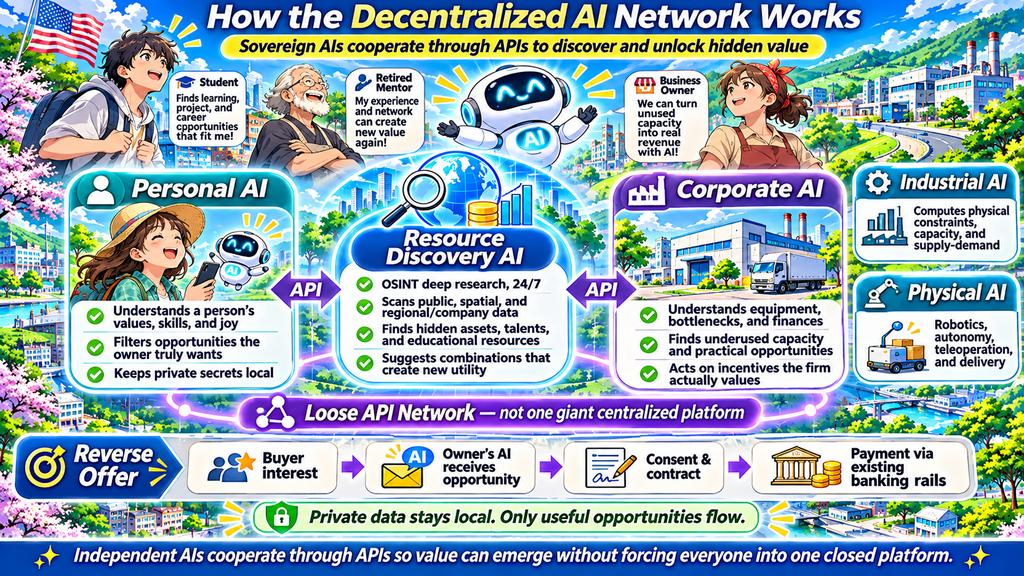
From an architectural standpoint, this system breaks away from today’s Big Tech platform economy, where personal preferences and internal corporate data are hoarded inside centralized servers. Instead, independent AIs cooperate through a “Loose API Network”—a sovereign, decentralized architecture where sensitive data stays with its owner.
1) Resource Discovery AI (Global OSINT Deep Research)
Operating 24/7/365, this engine continuously explores global public records, government and municipal statistics, satellite and spatial data, corporate disclosures, academic findings, and local community feeds. It uncovers underutilized resources nobody sees as products yet, idle assets whose owners do not even realize carry value, hidden individual aptitudes, and dormant educational resources—generating use-value hypotheses (“Who could combine this with what, and how, to create substantial utility?”) and publishing them through the Resource Discovery API.
2) Personal AI (Individual-Owned) & Corporate AI (Entity-Owned)
Every individual has a dedicated Personal AI, and every legal entity (company, cooperative, municipality, etc.) has a dedicated Corporate AI.
- Personal AI locally understands its owner’s values, strengths, learning aptitudes, life constraints, and—above all—what brings them genuine joy and fulfillment.
- Corporate AI locally understands the organization’s mission, equipment utilization rates, talent bottlenecks, operational challenges, and financial or credit constraints.
Crucially, private data stays local. Without ever exposing personal privacy or corporate trade secrets externally, these edge AIs communicate continuously with the Resource Discovery API, filtering global streams so that only useful opportunities their owners can truly appreciate and have strong incentives to act upon are delivered.
3. “Triple Delivery” and “Reverse Offers” That Drive the Economy
In conventional e-commerce and sharing-economy platforms, transactions only begin after a seller conceives a product, sets a price tag, and lists it on a marketplace for buyers to search.
In The Sattsu AI New Economy, AI proactively connects assets that sellers have never listed, resources whose owners have no idea anyone would pay for, and talents or educational opportunities that buyers didn’t even know existed. This works through three distinct stages of delivery—“Triple Delivery.”
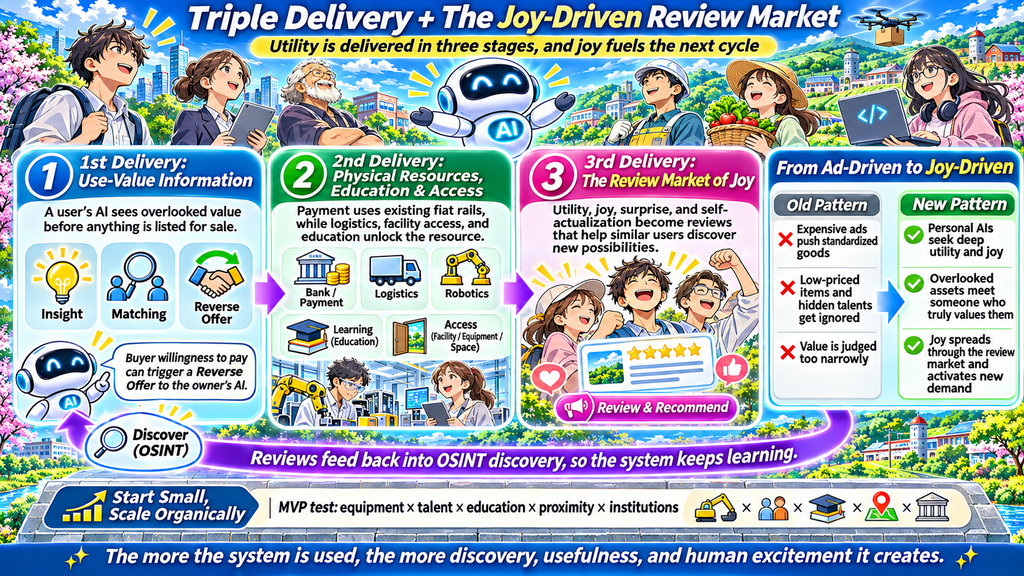
1st Delivery: “Use-Value Information” and the Reverse Offer
Before any physical object or person moves, information about overlooked use-value is delivered first. Hypotheses generated by the Resource Discovery AI—detailing where an underutilized resource exists and what utility or joy it can unlock—are routed via API to the Personal or Corporate AIs capable of recognizing its worth.
When the asset is not listed for sale, a prospective user’s willingness to pay triggers a “Reverse Offer” sent directly to the resource owner’s Personal or Corporate AI: “A buyer would like to use your idle facility (or byproduct, space, or skill) for this purpose at this compensation. Would you like to accept?” Only after verifying ownership, securing explicit consent, and clearing legal requirements is a standard sales, lease, or service contract executed.
2nd Delivery: Physical Resources, Education & Access Rights — Settled on Existing Financial Rails
Once both sides agree, the second delivery unlocks the resource itself. Rather than forcing participants to adopt speculative tokens or unfamiliar currencies, payments settle in existing fiat currencies (such as USD or JPY) using established banking rails, credit cards, invoicing, and credit facilities.
Delivery adapts seamlessly to the nature of each resource:
- Movable Goods: Delivered physically via existing logistics carriers, local couriers, or Physical AI such as autonomous delivery robots and drones.
- Facilities, Spaces, and Institutions: Instead of moving physical objects, access rights or usage rights are delivered so the user can utilize the site, equipment, or institutional framework.
- Undiscovered Individuals × Educational Resources: Executed as a two-step delivery—first delivering the educational resource (master coaching or training programs) to the individual, and then delivering their newly unlocked capability to the utilizing person or company. Because downstream demand and compensation are visible upfront, utilizing companies can easily sponsor training costs, or existing financial and credit providers can finance the education against future earnings.
3rd Delivery: Circulating Lived Experience Through “The Review Market of Joy” and Self-Evolution
The beating heart of this economic system is the third delivery. When an individual or organization actually uses a newly discovered resource—or when an undiscovered person blossoms through new education and opportunity—the resulting economic utility, problem-solving results, human joy, surprise, wonder, and self-actualization are captured as structured reviews.
Rather than a mere star-rating widget on a shopping site, this system features an independent “Review Market of Joy”:
- Structured reviews are delivered to other Personal and Corporate AIs facing similar challenges or sharing similar passions.
- Utility that was initially recognized only by the Resource Discovery AI and a single early adopter (“connoisseur”) now circulates as vivid, trustworthy lived experience—prompting second and third waves of users to say, “If it creates that kind of value and joy, we want it delivered too.”
- Most importantly, unexpected real-world applications discovered on the ground—uses that even the AI never anticipated—feed back into OSINT discovery, Personal AIs, and Corporate AIs.
Through this feedback loop, the system’s discovery algorithms and value hypotheses keep learning continuously. The more the system is used, the smarter, more useful, and more exciting it becomes.
4. Shifting from an “Ad-Driven Economy” to a “Joy-Driven Economy”
Today’s market economy follows an Ad-Driven pattern: sellers spend fortunes on mass advertising to stimulate demand for standardized goods. Moreover, because conventional markets compress all value into a single metric—monetary market price—low-priced items, unconventional assets, and unquantifiable human gifts are routinely ignored and discarded.
The Sattsu AI New Economy flips this paradigm into a Joy-Driven pattern.
While payments still settle cleanly in existing fiat money, each Personal AI evaluates opportunities along an entirely independent axis: how much deep utility and authentic joy this resource or opportunity will bring to its owner. There is never any need to force human joy or wonder into an artificial monetary score.
Factory offcuts, quiet rural spaces, or subtle personal talents that looked nearly worthless on open commodity markets meet the exact person or firm capable of cherishing them—sparking genuine excitement (“That solved our bottleneck!” “That was thrilling!” “I never knew my skill could matter this much!”). As that authentic joy spreads through the Review Market, it activates fresh demand and sets real money in healthy motion. Human joy itself becomes the primary engine of economic growth.
5. Starting Small, Scaling Organically via MVPs
No matter how grand a vision may be, waiting for society-wide regulatory reform or universal adoption means nothing ever begins. That is why this architecture starts small and scales organically through focused MVPs.
The core proposition our initial MVPs will test is straightforward: “Can AI combine multiple underutilized, heterogeneous resources—for instance, idle equipment × hidden human talent × educational resources × physical proximity × local cooperatives or institutions—to unlock far greater utility and human joy at a fraction of conventional costs?”
Once a single cycle succeeds within one community, one industrial cluster, or one specialized domain—generating measurable financial returns alongside genuine participant excitement—both the template and its reviews can propagate naturally across the API network to new regions and resource types.
We begin by seeding these core concepts and shared terms: OSINT Resource Discovery, Sovereign Personal & Corporate AIs, Reverse Offers, Triple Delivery, and The Review Market of Joy.
If this vision of The Sattsu AI New Economy resonates with you—whether you are an executive, engineer, researcher, investor, educator, or community builder who sees potential connections with dormant resources or challenges in your own field—I would love to hear your thoughts and explore our first real-world implementations together.